
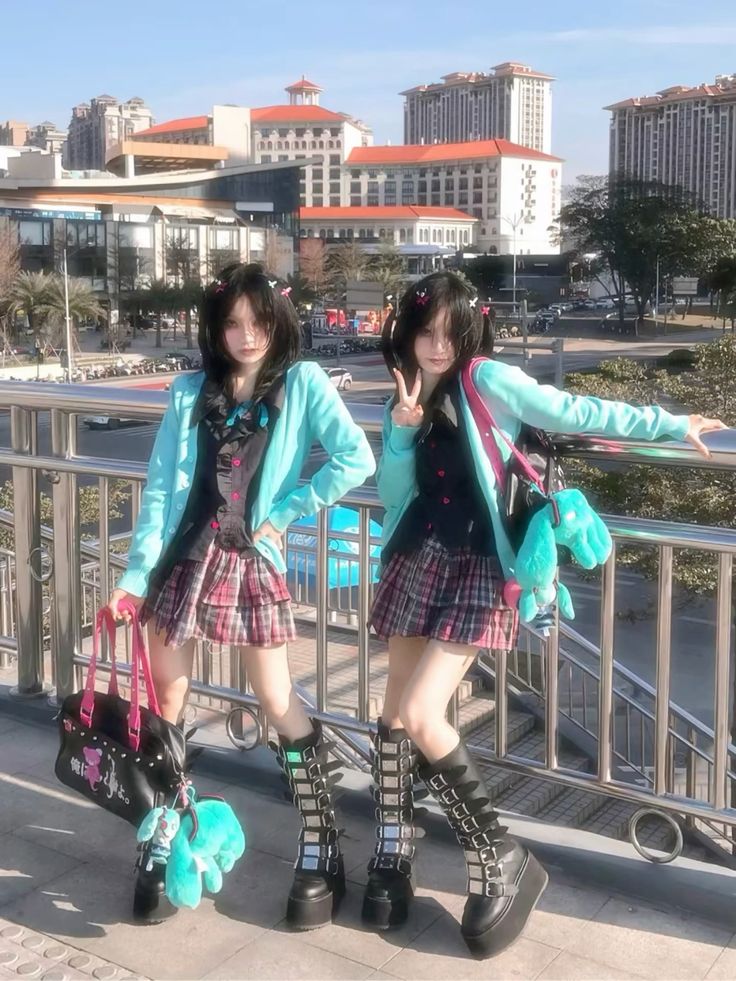
In East Asian countries, particularly Japan, South Korea, and China, it is not rare to encounter families, friends, or couples wearing matching outfits. In contrast, this culture of the matched outfit is quite uncommon in Western countries, but the popularity of this practice might rise.
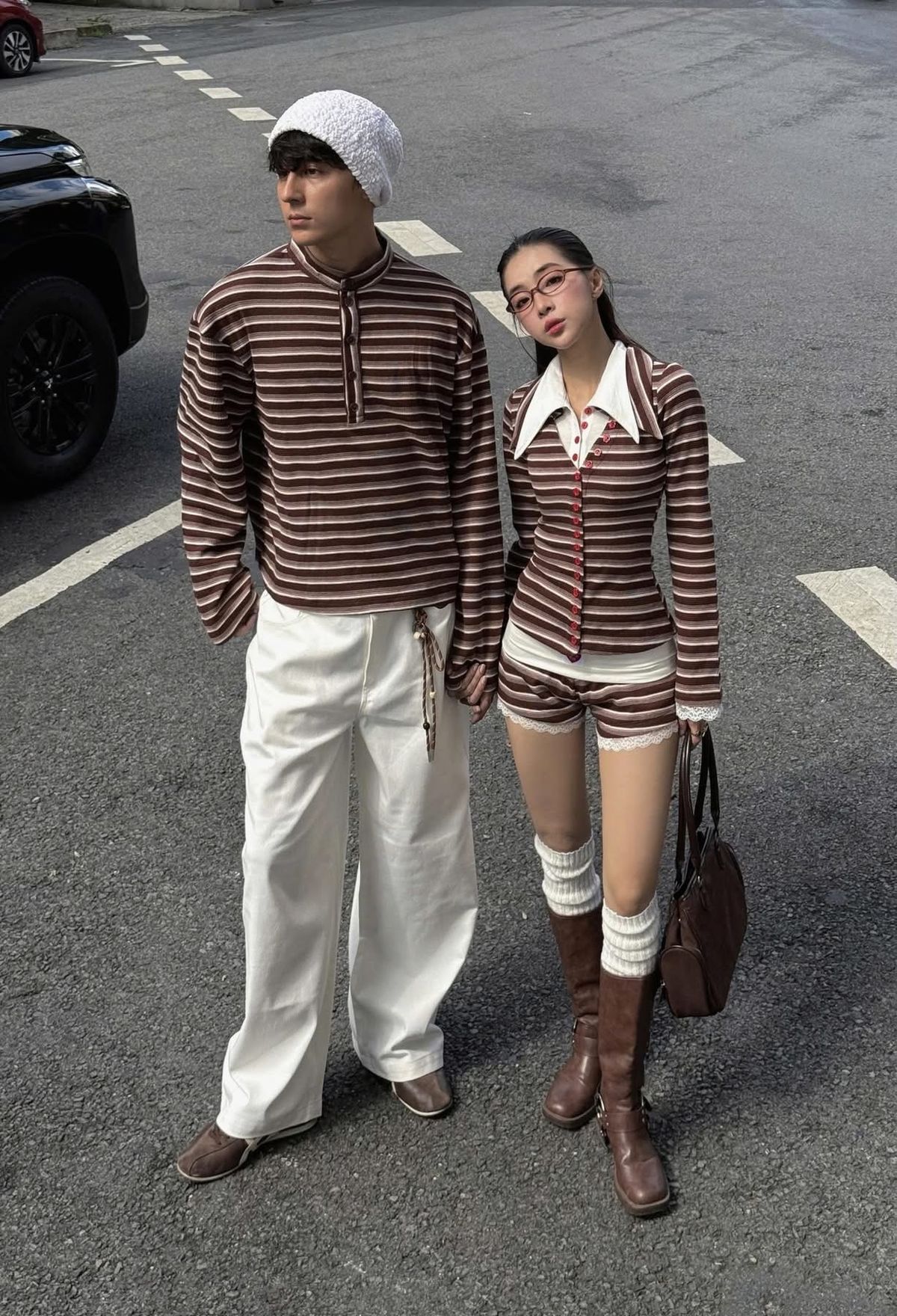
If the concept of matching outfits exists roughly everywhere in the world, it is more seldom in Western countries: more reserved for events such as concerts or festivals, it might be considered curious to match an outfit to a friend, a family member, or a partner in everyday life. In contrast, the opposite effects occur in Eastern countries, and this practice is widespread in Japan, South Korea, and China. But what can be defined as a matching outfit? From a single detail to an entire identical attire, the matching can materialize in the pattern of a fabric, in the color combo of the top and the bottom, in an accessory, or all put together. The main idea is to show a relation between two or more people, visibly identifiable by the rest of the population. In Japan, for example, a school uniform can be worn during an outing among friends to show belonging to the same social group, and it is not rare to meet a group of girls shopping on a rest day in their uniform. In South Korea, the matching outfit is more reserved for couples. It represents two partners as “officially” dating: it is a couple performance.
When harmony becomes visible online
Matching the outfits among people is not the same practice in every Eastern country, but it has gained the same popularity, especially with the development of social media. In a time where everything needs to be more and more aesthetic to value our life online, fashion is no exception. Who has never put their best outfit on just for an Instagram post? If it was already considered the pick of cuteness to match an outfit with a loved one, social media emphasized what is now a widespread phenomenon. Matching an outfit shows how special a bond is and strengthens a relationship to everyone’s eyes, showing how in sync two people or a group are. For a family, it shows how unified and healthy it is. For a couple, it roots their legitimacy in everyone’s mind and displays how well they belong together. At first sight, it is easy to see the relations between people. According to J’Nae Phillips, a trend forecaster and the creator of the Fashion Tingz newsletter, “[outfit matching] often functions as personal branding, an image of the couple that they want the world to internalise”, then she adds that today’s approach “is conceptually driven and often social media conscious”.
To capitalise on the relationship aesthetic
This idea of matching outfits is a real gold mine for clothes sellers, especially when it concerns heterosexual couples. Because fashion is extremely gendered, finding clothes with the same color scheme or the same pattern can be complicated. Businesses understood that principle pretty well and started to sell matching gendered clothes. On the website “Yesstyle”, a famous Korean seller, more than 1500 results appear for this research. Matching couple sets are really popular, and the clothes presented tend to differ drastically in gender expression. If it is the same shape, as a T-shirt for example, it is not rare to have different colors, with one considered way more feminine than the other. Women’s outfits are usually short skirts or flowy dresses to meet with feminine beauty standards. Sets usually match the textile, the pattern, the color, and any other particular details, such as a special fastening system or cute drawing, but each part of the set is clearly gendered.

The matching outfit functions as a strong symbol of what is perceived by Western audiences as “Asian cuteness”, a representation that often associates Asian bodies with softness, vulnerability and innocence ; and if the tendency is starting to get developed in Europe and America, it might be caused by the phenomenon of exotism inspired by Asian countries. Japan, South Korea, and China’s soft power, as K-pop or manga, tends to make these countries more and more popular in the rest of the world, and recognizable. Asian habits, such as matching outfits, might profit from this hype. A lot of Eastern fashion trends are followed in the West, such as keychains on our handbags or leg warmers, and matching outfits with family, friends, but more particularly partners, could reach our lives sooner than expected.

About the Author
Alma GLAYSE
Editor of Blazé.e.s magazine (2025-2026 edition) and Master’s student at the University of Fashion. I have just completed my studies in English and Japanese. I write articles offering a nuanced perspective on trends and news in the fashion world.